Graphic World

Categories
Post

The World’s 10 Tallest New Buildings of 2015

The World’s 10 Tallest New Buildings of 2015

The following list, originally published on BuzzBuzzHome, is based on data from the Council on Tall Buildings and Urban Habitat, the recognized authority on skyscraper height. 

With the number of officially “tall” buildings — at least 656 feet (200 meters) — doubling over the next ten years, and the number of “megatall” buildings — at least 1,969 feet (600 meters) — expected to jump from two to 10 by 2020, building construction around the world is literally reaching new heights.

Indeed, next year alone 10 new skyscrapers of at least 1,110 feet (338 meters) will be completed. They are 2015’s tallest buildings…

10. ADNOC Headquarters in Abu Dhabi, United Arab Emirates — 1,122 feet (342 meters)

© hok
© hok
© Georges Binder
© Georges Binder
 
© Mohd. Akhter Hasan/Flickr

Floors: 76
Global ranking upon completion: 62nd tallest
Interesting fact: The new headquarters for the Abu Dhabi National Oil Company is, somewhat ironically, being built to LEED Gold green building certification.
Photos: hok, CTBUH, Mohd. Akhter Hasan/Flickr

9. Forum 66 Tower 2 in Shenyang, China — 1,150 feet (351 meters)

 
Forum 66 Tower 2 in Shenyang, China — 1,150 feet. Image © z0rg/SkyscraperCity
 
Forum 66 Tower 2 in Shenyang, China — 1,150 feet. Image © z0rg/SkyscraperCity

Floors: 68
Global ranking upon completion: 56th tallest
Interesting fact: When fully complete, the 9.3 million-square-foot, multi-building complex will include a mall, hotel, office space, residential units and a subway. Tower 2, the office portion of the project, will be the tallest building in Shenyang.
Photos: z0rg/SkyscraperCity

8. OKO Tower in Moscow, Russia — 1,155 feet (352 meters)

 
OKO Tower in Moscow, Russia — 1,155 feet. Image © SOM
 
OKO Tower in Moscow, Russia — 1,155 feet. Image © Evrasia 99911/yandex

Height: 85
Global ranking upon completion: 55th tallest
Interesting fact: The tower is part of Moscow’s thriving International Business Center, a mixed-use district centrally located within the Russian metropolis and loosely based on London’s Canary Wharf and Paris’s La Défense. It was designed by Skidmore, Owings & Merrill, the same architecture firm behind One World Trade Center in New York City and the Burj Khalifa in Dubai.
Photos: SOM, Evrasia 99911/yandex

7. Vostok Tower in Moscow, Russia — 1,224 feet (373 meters)

 
via wikipedia. ImageVostok Tower in Moscow, Russia — 1,224 feet
 
via wikipedia. ImageVostok Tower in Moscow, Russia — 1,224 feet

Floors: 95
Global ranking upon completion: 43rd tallest
Interesting fact: Like OKO, the Vostok Tower is also part of Moscow’s fast-growing business district. Once the building is topped off, it will be the tallest in Europe.
Photos: wikipedia

6. Eton Place Dalian Tower 1 in Dalian, China — 1,257 feet (383 meters)
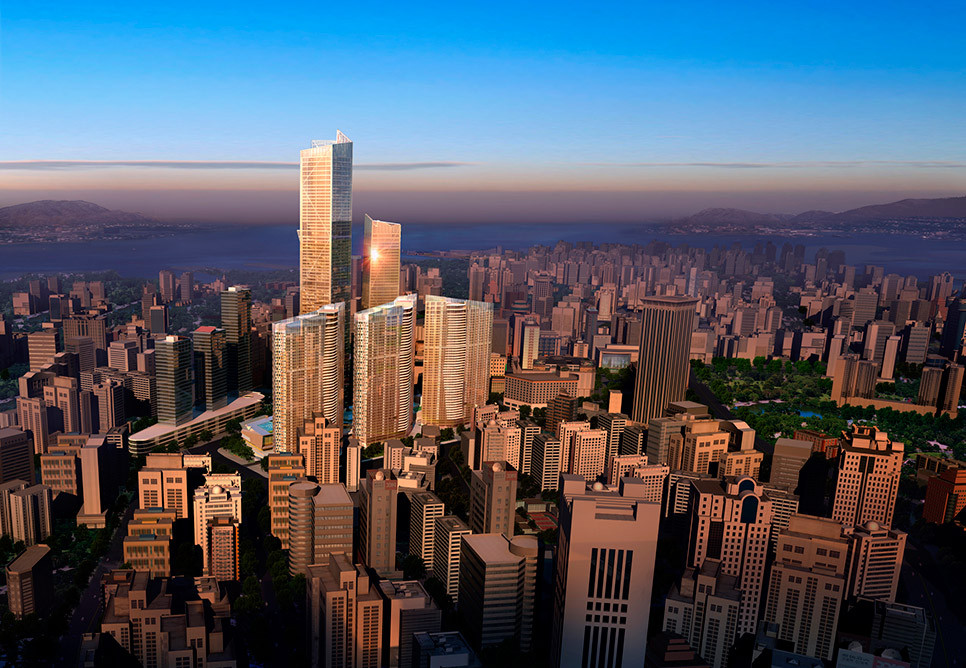
 
Eton Place Dalian Tower 1 in Dalian, China — 1,257 feet. Image © NBBJ
via Skyscraper Center. © Georges Binder. ImageEton Place Dalian Tower 1 in Dalian, China — 1,257 feet

Floors: 80
Global ranking upon completion: 37th tallest
Interesting fact:Eton Place Dalian Tower 1 is one of five skyscrapers in the Eton Place Dalian development, which also includes a 62-story building and four 42-story towers.
Photos: NBBJ, Skyscraper Center

5. Capital Market Authority Tower in Riyadh, Saudi Arabia — 1,263 feet (385 meters)

 
Capital Market Authority Tower in Riyadh, Saudi Arabia — 1,263 feet. Image © hok
© Andrew A. Shenouda/Flickr. ImageCapital Market Authority Tower in Riyadh, Saudi Arabia — 1,263 feet

Floors: 79
Global ranking upon completion: 34th tallest
Interesting fact: The tower’s external layer of fins, gantries and perforated panels are there to shade the building from the unrelenting desert sun.
Photos: hok, Andrew A. Shenouda/Flickr

4. 432 Park Avenue in New York City — 1,397 feet (426 meters)

The World’s 10 Tallest New Buildings of 2015
432 Park Avenue in New York City — 1,397 feet. Image © dbox for CIM Group and Macklowe Properties
via 432ParkAvenue.com. Image432 Park Avenue in New York City — 1,397 feet

Floors: 85
Global ranking upon completion: 22nd tallest
Interesting fact: As it has already been topped off, 432 Park Avenue is the tallest building in the the Western Hemisphere. The building’s most expensive unit on the market, Penthouse 94, is a full-floor, 8,255-square-foot six-bedroom with a $82.5 million price tag. That’s $9,994 per square foot.
Photos: dbox for CIM Group and Macklowe Properties, 432ParkAvenue.com

3. Marina 101 in Dubai — 1,399 feet (426 meters)

© Sheffield Holdings Limited. ImageMarina 101 in Dubai — 1,399 feet
© photo Q.Thang/Flickr. ImageMarina 101 in Dubai — 1,399 feet

Floors: 101
Global ranking upon completion: 21st tallest
Interesting fact: Construction on Marina 101, Dubai’s second tallest tower, originally began in 2006 but was stalled due to the global financial crisis. The project will finally be completed in the early part of 2015.
Photos: Sheffield Holdings Limited, photo Q.Thang/Flickr

2. Wuhan Center in Wuhan, China — 1,437 feet (438 meters)

© ECADI. ImageWuhan Center in Wuhan, China — 1,437 feet
via Wikimedia. ImageWuhan Center in Wuhan, China — 1,437 feet

Floors: 88
Global ranking upon completion: 19th tallest
Interesting fact: The tower’s aerodynamic shape was designed to reduce wind resistance and the vortex action that builds up around super-tall towers.
Photos: As+GG, Wikimedia

1. Shanghai Tower in Shanghai, China — 2,073 feet (632 meters)

© Gensler. ImageShanghai Tower in Shanghai, China — 2,073 feet
© Danijel J/Flickr. ImageShanghai Tower in Shanghai, China — 2,073 feet

Floors: 128
Global ranking upon completion: 3rd tallest
Interesting fact: The topped off construction site is a favorite target of so-called “rooftoppers,” daredevils who scale tall buildings without safety equipment for fun.
Photos: Gensler, Danijel J/Flickr

Categories
Post

Top 10 biggest dams

Russia and Canada have three dams each of the world’s 10 biggest dams, while Africa hosts two, and Egypt and Venezuela have one each. Water-technology.com profiles the 10 biggest dams in the world by reservoir storage capacity.

Akosombo is the world's largest dam in terms of water storage capacity

Kariba Dam, Zimbabwe

Kariba Dam is the world’s biggest dam based on water storage capacity. Located at the former Kariwa (Kariba) Gorge, the dam creates Lake Kariba, which has a storage capacity of 185 billion cubic metres of water and a surface area of 5,580km2. The Lake Kariba covers a length of 280km and is 32km wide at its widest section.

The double curvature concrete arch dam is owned by Zambezi River Authority and was constructed between 1955 and 1959 by Impresit of Italy. The dam is designed to avert a one in 10,000-year flood event.

The dam is 128m high, 617m in length, and was constructed using 1.036 million cubic metres of concrete. It comprises of two power stations generating a combined 1,470MW of energy, which constitutes approximately 60% of the hydropower outputs for Zambia and Zimbabwe.

Bratsk Dam, Russia

Bratsk Dam in Siberia, Russia, ranks as the second biggest dam in the world thanks to its 169.27 billion cubic metres reservoir. The dam impounds the Angara River and the reservoir created by it covers a surface area of 5,540km2.

The concrete gravity dam is owned by Irkutskenergo and was constructed from 1954 to 1964 by Bratskgesstroy (formerly Nizhneangargesstroy management).

The dam is 125m high and 1,452m in length, and has a rail line and a highway on its top. The power plant at the dam has an installed capacity of 4,500MW comprising of 18 Francis turbines.

Akosombo Dam, Ghana

Akosombo dam, located in Ghana, is the third biggest dam based on water storage capacity. Constructed on the Volta River, the dam creates the 8,500km2 Lake Volta, which is the world’s biggest reservoir by surface area. The lake impounds a mammoth 144 billion cubic metres of water.

The rock-fill embankment dam has a crest length of about 700m and a height of 134m, and involved 12 million cubic metres of surface excavation. It was constructed from 1961 to 1966 primarily for the purpose of electricity generation, but also provides a livelihood for about 300,000 people through fisheries in the lake.

Volta River Authority owns the dam and IMPREGILO-Italy was the main construction contractor. The power plant at the dam consists of six turbo generator units rated at 128,000kW each.

Daniel Johnson Dam, Canada

The Daniel Johnson Dam, also known as Manic 5 Dam, impounds the Manicouagan River that creates the Manicouagan Reservoir with a storage capacity of 139.8 billion cubic metres. The reservoir, having a surface area of 1,973km2, is the fourth biggest in the world.

The dam is also touted as the world’s biggest hollowbody multiple-arch-and-buttress dam. It is 1,310.6m long and 213.97m high, and features 14 buttresses and 13 arches. It was constructed using 2.2 million cubic metres of concrete.

The dam is owned by Hydro-Québec and was constructed from 1959 to 1968. The dam’s two power stations feature 12 units with a combined installed capacity of 2,660MW.

Guri Dam, Venezuela

Guri, the world’s fifth biggest dam, has a storage capacity of 135 billion cubic metres and creates the Guri Lake covering 4,000km2. The concrete gravity and embankment dam measures 1,300m in length and 16m in height, and provides for 70% of the country’s electricity needs. It is operated by CVG Electrification del Caroni CA (Edelca).

The dam’s construction was carried out in two stages, which commenced in 1963 and completed in 1986. The Guri hydropower facility has an installed capacity of more than 10,000MW. A modernisation project for the dam is also currently underway involving ABB as the main contractor.

Aswan High Dam, Egypt

The Aswan High Dam, which impounds the River Nile and creates Lake Nasser, is the sixth biggest dam based on water storage capacity. The dam’s reservoir, Lake Nasser, has a water storage capacity of 132 billion cubic metres.

The rock-fill dam was designed by Institute Hydroproject of Russia in collaboration with various engineers from Egypt. It was constructed from 1960 to 1968 with an investment of approximately $1bn. The dam’s power plant is equipped with 12 Francis turbines with a combined installed capacity of 2,100MW.

The multipurpose dam serves the irrigation needs of both Egypt and Sudan, controls flooding, generates power, and helps in improving navigation across the Nile. It is 111m in height, 3,830m in length, and has a base width of 980m. Its single spillway has a water discharge capacity of 11,000 cubic metres a second.

W.A.C Bennett Dam, Canada

W.A.C Bennett Dam, constructed on the Peace River in British Columbia, Canada, creates the Williston lake. The dam ranks as the seventh largest with a storage capacity of approximately 74 billion cubic metres and covers a surface area of 1,773km2.

The earth fill embankment dam is operated by B.C Hydro, and has a height of 183m andcrest length of 2,068m. The construction of the dam was commenced in 1961 and completed in 1967.

The power generating station at the dam, known as the G.M. Shrum Generating Station, has an installed capacity of 2,790MW and started generating electricity in 1968.

Krasnoyarsk Dam, Russia

The world’s eighth biggest dam is the Krasnoyarsk Dam, which impounds the Yenisey River and creates the Krasnoyarskoye reservoir with a storage capacity of 73.3 billion cubic metres. The reservoir covers a surface area of 2,000km2 and has a shoreline of approximately 1,560km.

The concrete gravity dam is 124m high, 1,065m in length, and was constructed from1956 to 1972. It is designed with a flood discharge capacity of 20,400m3 per second.

The power station of the dam features 12 units with a combined installed capacity of 6,000MW, used primarily to power aluminium plants owned by RUSAL Company. The water from the reservoir also serves the purpose of irrigation.

Zeya Dam, Russia

The Zeya Dam, built on the Zeya River in the Amur Oblast of Russia, north of the Chinese border, creates the Zeya reservoir with a storage capacity of 68.42 billion cubic metres, which is the ninth biggest dam based on reservoir capacity. The reservoir covers a surface area of 2,419km2.

The concrete gravity dam has an overall height of 112m, a crest length of 714.2m, and was constructed utilising 2.067 million cubic metres of concrete.

The Zeya Dam is owned by RusHydro and was constructed by Zeyagesstroy and Bureyagesstroy from 1964 to 1975. The dam’s power plant comprises of six generating units with a combined installed capacity of 1,290MW. The power plant features the world’s first adjustable-blade diagonal-flow turbines.

Robert-Bourassa Dam, Canada

The Robert Bourassa Dam impounding the La Grande River in northern Quebec, Canada, creates the Robert-Bourassa Reservoir. It is the world’s tenth biggest dam and has a reservoir capacity of 61.7 billion cubic metres covering a surface area of 2,815km2.

The embankment dam is 162m high and 2,835m in length, and features a spillway which has a capacity to release17,600m3 of water per second.

The dam is owned by Hydro-Québec and was constructed from 1974 to 1981. The dam’s two power plants are fitted with 16 Francis turbines having a combined installed capacity of 5,616MW. Alstom is carrying out a major refurbishment and upgrade of the dam’s power stations.

Categories
Post

Top 10 Museum in the World

Picture of the Louvre Museum seen through the Pyramid glass, Paris, France

  1. Smithsonian Institution, Washington, D.C.

    The Smithsonian is the world’s largest research and museum complex, with 19 museums and galleries, the National Zoological Park, and various research stations. More than 137 million objects detailing America’s story are housed here, so you’d better prepare for a long week of walking. There’s so much to see that, if you spent one minute day and night looking at each object on exhibit, in ten years you’d see only ten percent of the whole. Therefore, it’s wise to head out with a plan. Focus on only one or two exhibits at two or three different museums.

    Main attractions: Dorothy’s ruby red slippers, the dresses of the First Ladies, and the original Star-Spangled Banner at the National Museum of American History; the Gem Hall (including the Hope Diamond) at the National Museum of Natural History; and the Wright brothers’ 1903 Flyer, the Spirit of St. Louis, and the Apollo 11 command module at the National Air and Space Museum.

  2. Le Louvre, Paris, France

    The Louvre was a medieval fortress and the palace of the kings of France before becoming a museum two centuries ago. The addition of I. M. Pei’s pyramid shocked many when it was unveiled in 1989 as the new main entrance, yet it somehow works, integrating the palace’s disparate elements. The museum’s collections, which range from antiquity to the first half of the 19th century, are among the most important in the world. A good place to start is the Sully Wing, at the foundations of Philippe-Auguste’s medieval keep—it’s in the heart of the Louvre, kids love it, and it leads straight to the Egyptian rooms.

    Main attractions: “Venus de Milo,” “Winged Victory of Samothrace,” and Leonardo da Vinci’s “Mona Lisa.”

  3. The Acropolis Museum, Athens, Greece

    The stunning ground floor gallery houses finds from the slopes of the Acropolis. Its amazing transparent glass floor provides a walk over history, with a view of the archaeological excavation, while sloping upward to the Acropolis with sanctuaries of the Athenians from each historic period nearby. Smaller settlements have been excavated, yielding glimpses of Athenian life. For the first time, the exhibits in the Archaic Gallery allow visitors to take in all sides of the objects, which are displayed in open spaces characterized by changing natural light.

    Main attractions: The frieze of the Parthenon is mounted on a structure with exactly the same dimensions as the cella of the Parthenon, giving comprehensive viewing of every detail.

  4. State Hermitage, St. Petersburg, Russia

    Russia may be isolated from the artistic centers of Paris, Rome, and London, butthe Hermitage has managed to acquire a spectacular collection of world art—more than three million items—spanning the years from the Stone Age to the early 20th century. The museum occupies six buildings along the Neva River, the leading structure being the confection-like Winter Palace. This gloriously baroque, blue-and-white structure was finished in 1764 and over the next several centuries was the main residence of the czars. Catherine the Great founded the museum that same year when she purchased 255 paintings from Berlin. The museum’s focal point is Western European art—120 rooms in four buildings ranging from the Middle Ages to the present day. Rembrandt, Rubens, Tiepolo, Titian, da Vinci, Picasso, Gauguin, Cézanne, van Gogh, and Goya are all represented here. For in-depth tours, contact Glories of the Hermitage.

    Main attractions: The Treasure Gallery’s Gold Rooms showcase golden masterpieces from Eurasia, the Black Sea Littoral in antiquity, and the Orient. The museum also houses pieces from Nicholas II’s private collection, including paintings, drawings, and medals created to commemorate his coronation.

  5. The British Museum, London, England

    Britain’s largest museum looks after the national collection of archaeology and ethnography—more than eight million objects ranging from prehistoric bones to chunks of Athens’ Parthenon, from whole Assyrian palace rooms to exquisite gold jewels.

    Main attractions: The Egyptian gallery boasts the world’s second finest collection of Egyptian antiquities outside Egypt, including the Rosetta Stone, carved in 196 B.C.

  6. The Prado, Madrid, SpainThe Spanish royal family is responsible for the Prado’s bounty of classical masterpieces. Over centuries, kings and queens collected and commissioned art with passion and good taste. In addition to stars of Spanish painting such as Velázquez, Goya, Ribera, and Zurbarán, the Prado has big collections of Italian (including Titian and Raphael) and Flemish artists. Fernando VII opened the collection to the public in 1819, in the same neoclassic building it’s housed in today, designed by Juan de Villanueva.

    Main attraction: “The Three Graces” by Rubens.

  7. The Metropolitan Museum of Art, New York City, New YorkThe Metropolitan Museum of Art is the largest museum in the Western Hemisphere. Its collection of more than two million items is not only broad—covering the entire world, from antiquity to the present—but deep, with holdings so large in a number of areas that some might be considered museums unto themselves. Its European paintings are stunning: works by Botticelli, Rembrandt, Vermeer, Degas, Rodin, and other luminaries. The Egyptian Collection showcases the tomb of Perneb (circa 2440 B.C.) and the exquisite Temple of Dendur (circa 23-10 B.C.). The American Wing contains American arts and crafts, including a room from a Frank Lloyd Wright Prairie House. And the list goes on and on.

    Main attractions: “Adam and Eve,” the well-known engraving by Albrecht Dürer, is only one of the many impressive pieces you will discover at the Met.

  8. The Vatican Museums, Vatican City, ItalyTwenty-two separate collections comprise the Musei Vaticani, each one more spectacular than the next. The most famous are probably the Museo Pio-Clementino, with its splendid classical sculpture; the Raphael Rooms, entire rooms painted by Raphael; the Pinacoteca (picture gallery), which contains the cream of the Vatican’s collection of medieval and Renaissance paintings; and, of course, Michelangelo’s Sistine Chapel. But there is also the ancient Egyptian exhibits of the Museo Gregoriano Egizio, as well as the Etruscan offerings of the Museo Gregoriano Etrusco. And that’s just a start.

    Main attractions: The renowned Sistine Chapel and the Raphael Rooms are not to be missed.

  9. The Uffizi Gallery, Florence, Italy“Great” is an overworked adjective in Italy, where so many of the country’s monuments and works of art command the highest praise. In the case of the Galleria degli Uffizi, it barely does justice to a gallery that holds the world’s finest collection of Renaissance paintings. All the famous names of Italian art are here—not only the Renaissance masters, but also painters from the early medieval, baroque, and Mannerist heydays.

    Main attraction: “The Birth of Venus” by Botticelli is one.

  10. Rijksmuseum, Amsterdam, the NetherlandsAbout 900,000 objects fill the Rijksmuseum, the largest collection of art and history in the Netherlands. It is most famous for its paintings by 17th-century Dutch masters, including Ruysdael, Frans Hals, Johannes Vermeer, and Rembrandt van Rijn. Established in 1800 to exhibit the collections of the Dutch stadtholders, the Rijksmuseum also displays art from the Middle Ages. The main building is closed for renovation until 2013; collection highlights are displayed in the Philips Wing and at Rijksmuseum Schiphol.