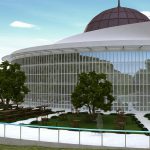
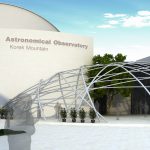
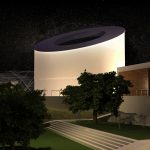
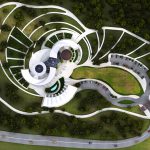
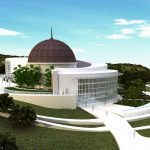
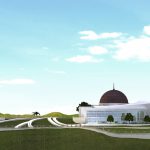
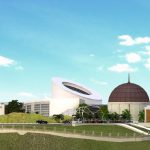
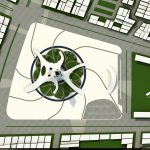
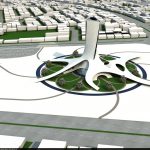
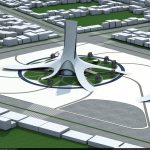
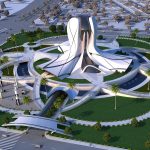
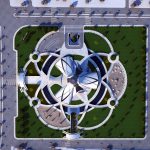
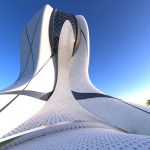
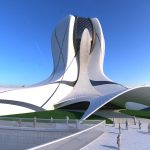
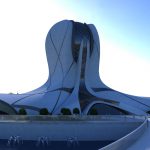
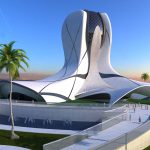
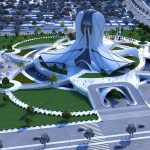
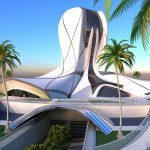
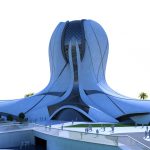
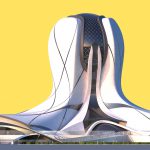
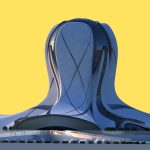
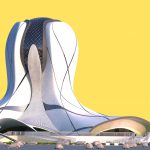
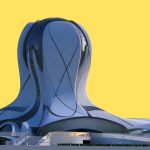
An observatory is a location used for observing terrestrial or celestial events. Astronomy, climatology/meteorology, geophysical, oceanography and volcanology are examples of disciplines for which observatories have been constructed. Historically, observatories were as simple as containing an astronomical sextant (for measuring the distance between stars) or Stonehenge (which has some alignments on astronomical phenomena).
Space Museum | Educational-Thesis | 2016 | Erbil | Public | Proposed
Description:
The Space Museum is the seventh serial of the second season in the British science fiction television series Doctor Who, which was first broadcast in four weekly parts from 24 April to 15 May 1965. Set in a space museum on the planet Xeros, the serial has the time traveler the First Doctor (William Hartnell) and his travelling companions Ian Chesterton (William Russell), Barbara Wright (Jacqueline Hill), and Vicki (Maureen O'Brien) looking for a way to change their fate after seeing themselves turned into museum exhibits in the future.
Erbil, is the largest city and capital of the Kurdistan Region in Iraq. It is located 88 kilometres (55 miles) east of Mosul and has a permanent population of approximately 1.5 million as of 2013. Urban life at Erbil (Hewlêr) can be dated back to at least 6000 BC,and it is one of the oldest continuously inhabited cities in the world.[1][2] At the heart of the city is the ancient Citadel of Arbil. In the early part of the 3rd millennium BC, the Hurrians from Asia Minor were the first to establish Urbilum and expand their rule to parts of northern Mesopotamia. The city became an integral part of Assyria from the 25th century BC to the 7th century BC, but after it lost its independence at the end of the 7th century BC, both Assyria and the city of Erbil were under the rule of many regional powers in turn, including the Babylonians, the Medes, the Persians and Greeks. Following the Arab Islamic conquest of Mesopotamia, the Arabs dissolved Assyria (then known as Assuristan/Athura) as a geo-political entity in the mid-7th century AD, and during medieval times the city came to be ruled by the Seljuk and Ottoman Turks. Erbil's archaeological museum houses a large collection of pre-Islamic artifacts, and is a center for archaeological projects in the area.
Kirkuk is a Kurdish city 236 kilometres (147 mi) north of Baghdad, and 83 kilometres (52 miles) south of Erbil. It is the capital of Kirkuk Governorate.
Kirkuk lies in a wide zone with an enormously diverse population, which has moreover experienced dramatic demographic changes in the course of the twentieth century. The city has been multilingual for centuries, and the development of distinct ethnic groups was a process that took place over the course of Kirkuk’s urbanization in the twentieth century.Kurds, Turkmen, Assyrians and Arabs lay conflicting claims to this zone, and all have their historical accounts and memories to buttress their claims.
The city sits on the site of the ancient Hurrian southern capital of Arrapha, which sits near the Khasa River on the ruins of a 5,000-year-old settlement (Kirkuk Citadel). It became known as Arrapha under the domination of the Hurrians—pre-Aryan peoples. The city reached great importance again under the later, but short-lived Assyrians in the 10th and 11th centuries BC. Because of the strategic geographical location of the city, Kirkuk was the battle ground for three empires—the Neo-Assyrian Empire, Babylonia, and Media—which controlled the city at various times.